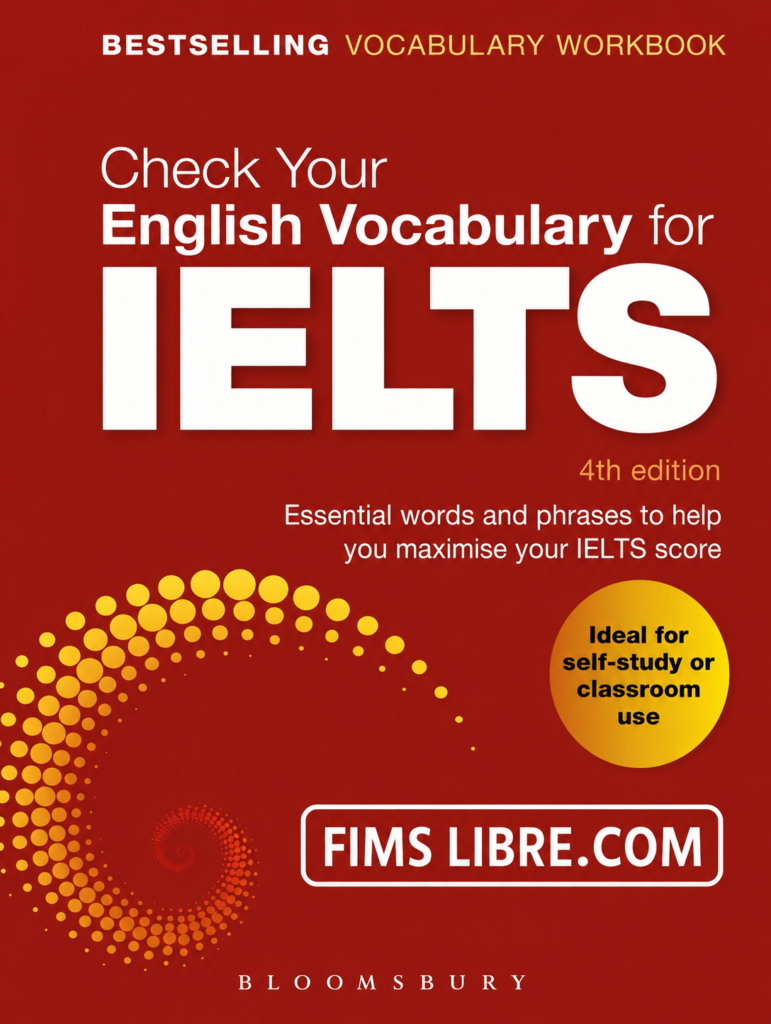
Check Your English Vocabulary for IELTS (4th Edition) – My Honest Review
First Impressions
When I started reading Check Your English Vocabulary for IELTS, I assumed it would be another workbook filled with long vocabulary lists and repetitive exercises. Surprisingly, it felt much more practical than I expected. Instead of asking readers to memorize random words, it focuses on vocabulary that frequently appears in IELTS contexts. As someone who prefers learning words through practice rather than endless lists, I found this approach much more useful.
The book isn’t designed to be read from beginning to end like a novel. It’s more of a workbook that encourages you to spend time with each section, complete the exercises, and gradually build your vocabulary.
A Quick Walk Through the Content
The book is structured around a wide range of vocabulary topics that are highly relevant to the IELTS exam. Rather than presenting isolated words, it introduces them through exercises that require learners to think about meaning, context, spelling, collocations, synonyms, and correct usage.
Many chapters focus on everyday academic themes such as education, work, health, travel, science, technology, environment, business, society, culture, and communication. These are exactly the kinds of topics candidates often encounter in IELTS Reading, Writing, Listening, and Speaking.
The activities vary throughout the book, which helps prevent learning from becoming repetitive. Readers complete gap-fill exercises, matching tasks, sentence completion activities, word formation practice, phrasal verbs, idioms, collocations, and multiple-choice questions. Instead of simply testing memory, many exercises encourage learners to understand how vocabulary naturally fits into sentences.
One feature I appreciated was the emphasis on commonly confused words and academic expressions. These are the small details that often make a noticeable difference in IELTS performance. The answer key also allows learners to study independently and check their progress after each section.
Although vocabulary is the primary focus, the exercises indirectly strengthen reading comprehension and writing skills because learners constantly see words used in realistic contexts. The progression feels logical, moving from general vocabulary toward more specialised language without becoming unnecessarily difficult.
Overall, the workbook functions as both a study guide and a revision tool, making it suitable for learners preparing over several weeks or months rather than trying to cram everything at once.
My Reading Experience
Honestly, I enjoyed this workbook more than I thought I would. Vocabulary books can sometimes feel dry, but this one kept me engaged because I was actively solving exercises instead of passively reading explanations.
I found myself recognising words that I’d seen before but never fully understood. Working through the exercises helped me realise how many English words have similar meanings but are used differently depending on the situation. That was probably one of the most valuable parts of the experience.
I also liked the flexibility. Some days I completed only two or three pages, while on other days I worked through an entire topic. It never felt like I had to follow a strict schedule.
What I Liked (and Didn’t Like)
One of the biggest strengths is the practical nature of the exercises. Rather than asking readers to memorise long vocabulary lists, the workbook encourages active learning through varied practice. I also appreciated the wide range of IELTS-related topics, which makes the vocabulary feel immediately useful for both the exam and everyday English. The answer key is another advantage because it allows self-study without needing a teacher.
That said, there are a few things I wasn’t completely satisfied with. To be fair, the pages contain very little visual content, so learners who prefer colourful layouts may find the design a bit plain. Some exercise formats also become slightly repetitive after working through several chapters. Maybe it’s just me, but I occasionally wished there were a few longer reading passages where the newly learned vocabulary could be seen in larger contexts. That would have made revision even more effective.
Who Will Probably Benefit Most?
I think this workbook is best suited for learners preparing for the IELTS exam who already have an intermediate level of English. Beginners may find some sections challenging because the vocabulary assumes a basic understanding of English grammar and sentence structure.
It’s also a great option for self-learners. Since every exercise includes answers, it’s easy to identify mistakes and revisit weaker areas without relying on classroom instruction. Teachers could also use individual chapters as homework or revision activities for their students.
Final Thoughts
Looking back, this workbook proved to be much more than a simple collection of vocabulary exercises. It helped me think more carefully about how English words are actually used rather than simply expanding the number of words I knew.
While the layout is fairly simple and a little more variety in some activities would have been welcome, those are relatively minor drawbacks. The content itself is practical, well organised, and closely connected to the vocabulary needed for IELTS success.
Overall, I finished the book feeling more confident about my vocabulary and more aware of the small language details that matter in the exam. If you’re preparing for IELTS and want structured vocabulary practice that goes beyond memorisation, this workbook offers a steady and realistic way to improve over time.
Join Our Facebook Learning Groups
🇩🇪 Learn German Free 🇬🇧 English Learning Group 🇪🇸 Spanish Learning GroupJoin our educational Facebook communities to improve your language skills, practice daily conversations, and connect with learners from around the world.