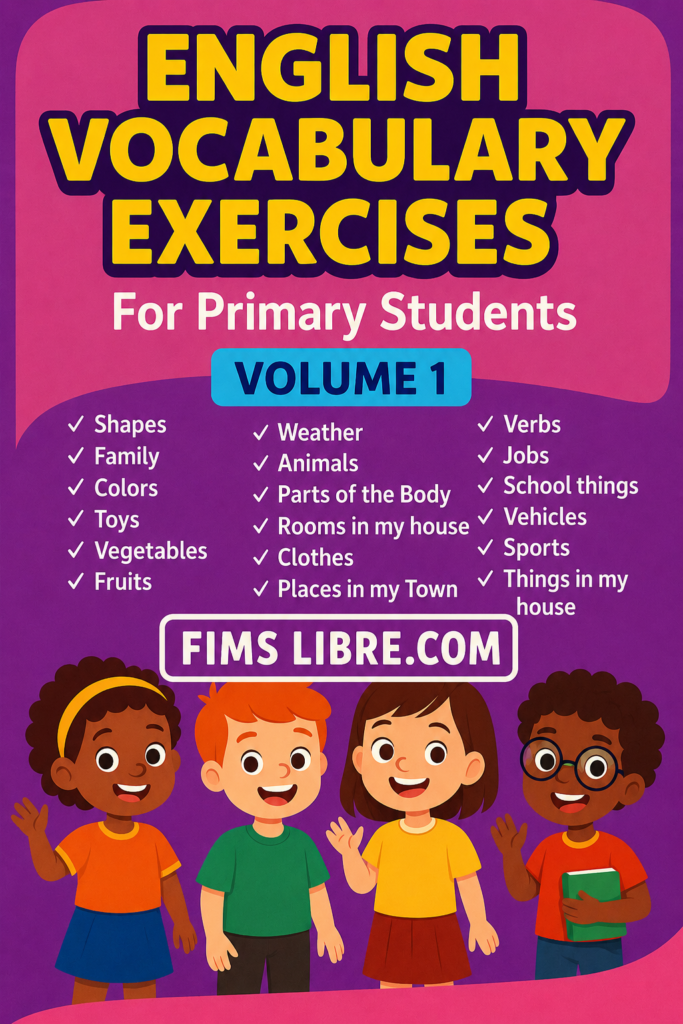
English Vocabulary Exercises for Primary Students (Volume 1) – My Honest Review
What’s This Book Really About?
At first glance, this looks like a simple vocabulary workbook for young learners, but after spending some time with it, I realized it does a good job of covering many of the everyday words that children are expected to know in basic English. Rather than introducing random vocabulary, the book organizes everything into familiar themes that children encounter in daily life.
The lessons begin with easy topics such as shapes, colours, family members, toys, fruits, and vegetables. As the book moves forward, it introduces more practical vocabulary including animals, weather, parts of the body, clothes, rooms in a house, places around town, school items, vehicles, sports, jobs, and common verbs. Because each section focuses on a single topic, the learning process feels organised instead of overwhelming.
What I appreciated most was the repetition. New words appear alongside matching activities, simple exercises, and review tasks that encourage children to use the vocabulary rather than simply memorise it. There are plenty of opportunities to recognise pictures, complete missing words, match items, and practise spelling. For younger learners, this kind of repetition is actually helpful because it builds confidence little by little.
Another thing I noticed was that the vocabulary stays practical. These are words children can immediately use when talking about themselves, their family, school, home, or favourite activities. The exercises remain short and manageable, making the workbook suitable for classroom lessons as well as independent practice at home.
The overall difficulty also feels appropriate for primary students. It starts with very basic concepts before gradually introducing slightly larger vocabulary sets, so children aren’t expected to learn everything at once.
My Reading Experience
Honestly, I wasn’t expecting a vocabulary workbook to keep my attention for very long, but I found myself appreciating how straightforward everything was. It doesn’t try to do too much, and I think that’s actually one of its biggest strengths.
As I flipped through the pages, I imagined how a young learner would interact with the activities. Most exercises are simple enough that children can complete them without becoming discouraged, yet they’re varied enough to avoid feeling repetitive after every page.
I also liked that the book doesn’t depend on long explanations. Instead, it encourages learning by seeing, reading, matching, and practising. For younger students, that’s usually far more effective than reading lengthy grammar notes.
What I Liked (and Didn’t Like)
One of the biggest strengths of this workbook is its clear organisation. The vocabulary is divided into familiar topics like family, animals, school items, colours, and weather, making it easy for children to focus on one subject at a time. I also liked the colourful illustrations, which make the pages feel welcoming rather than overwhelming. The activities are short and straightforward, so young learners can complete a lesson without losing interest. Honestly, I found that the gradual progression from simple words to slightly larger vocabulary lists makes learning feel natural instead of rushed.
That said, the book isn’t perfect. Some exercises follow the same pattern repeatedly, so after a while they can start to feel a bit predictable. I also found myself wishing there were a few short reading passages or simple dialogues using the new vocabulary. Seeing the words in real-life sentences would make the learning experience even stronger. If I’m being realistic, children who already have a good grasp of basic English may finish the workbook quite quickly because the difficulty level remains focused on beginners.
Overall, the positives easily outweigh the negatives. While there are a few areas that could have been expanded, the workbook succeeds in providing a solid, enjoyable foundation for young learners building their English vocabulary.
Who Will Probably Enjoy This?
I think this workbook is best suited for primary school students who are just beginning to build their English vocabulary. It would also work well for parents teaching their children at home or teachers looking for additional classroom practice.
Children who enjoy colourful activities, matching games, and short exercises will probably stay engaged throughout the book. Since each lesson can be completed in a relatively short time, it’s also a practical option for daily revision without making learning feel like a chore.
Final Thoughts
Looking back, I think this workbook succeeds because it stays focused on its main goal—helping young learners build a strong vocabulary foundation through simple and enjoyable practice. It doesn’t try to be a complete English course, and that’s perfectly fine.
While I would have liked to see a little more variety in the exercises and a few short reading sections, those are fairly minor issues compared to the overall quality of the material. The vocabulary is practical, the layout is child-friendly, and the gradual progression makes learning feel comfortable rather than overwhelming.
Overall, I finished the book with a positive impression. For young learners who are beginning their English journey, it provides a structured and approachable way to learn everyday vocabulary while keeping lessons fun, colourful, and easy to follow.
Join Our Facebook Learning Groups
🇩🇪 Learn German Free 🇬🇧 English Learning Group 🇪🇸 Spanish Learning GroupJoin our educational Facebook communities to improve your language skills, practice daily conversations, and connect with learners from around the world.