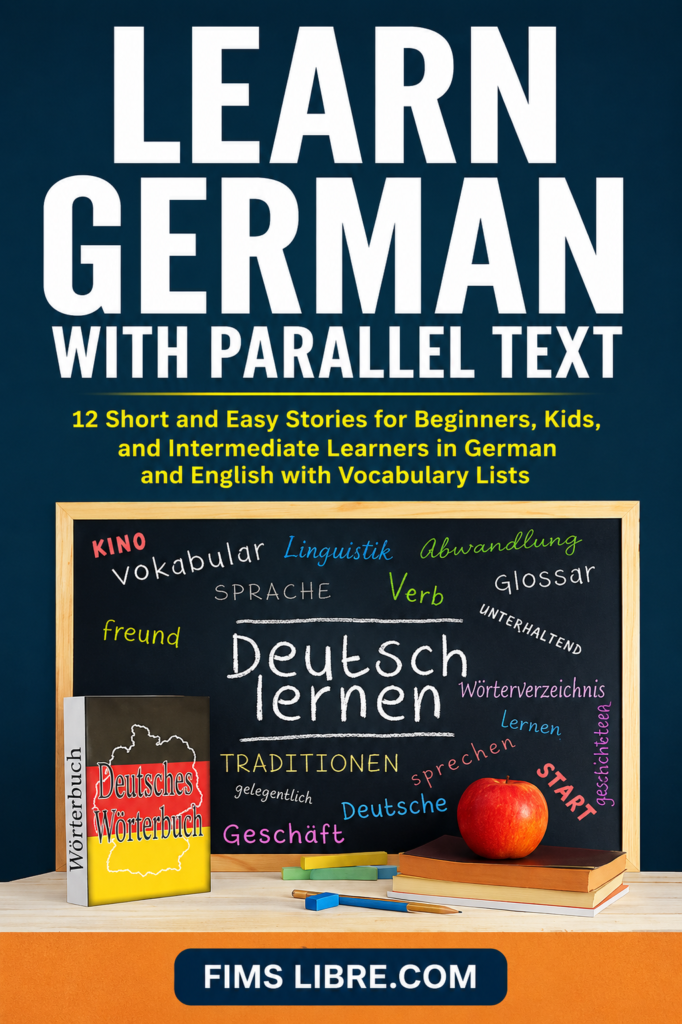
First Impressions
When I first picked up this book, I honestly wasn’t expecting such a straightforward, repetitive structure. At a glance, it looks like a collection of simple life stories, but as I started reading, I realized it’s clearly designed for someone trying to bridge the gap between absolute beginner and intermediate language learner. Each “Geschichte” (story) is presented first in German and then immediately followed by its English counterpart.
What surprised me most was the pacing. The book doesn’t waste time with complex theory; it throws you directly into daily routines—getting up, eating breakfast, going to work, and family dynamics. It felt a bit like reading a series of journal entries written by a very earnest neighbor. If you’re looking for a literary masterpiece, this isn’t it, but if you’re looking for a way to see how common sentence structures and vocabulary function in context, it does exactly what it says on the tin.
What’s This Book Really About?
The book’s core purpose is language acquisition through narrative. It covers everyday life scenarios across twelve stories, ranging from a boy who loves the sea to a couple managing a restaurant and preparing for a new baby. The learning approach is entirely immersion-based. There are no grammar drills or dry explanations of verb conjugations here.
Instead, the book relies on the “read and compare” method. You read a German story, and if you get stuck on a word or phrase, the English version right below acts as an immediate safety net. The vocabulary lists provided after each story are decent, but I found myself ignoring them mostly because the translation was already right there on the page.
The book doesn’t waste time with complex theory; it throws you directly into daily routines—getting up, eating breakfast, going to work, and family dynamics.
My Reading Experience
I found the dialogue style to be quite repetitive, which I suppose is the point, but it did make for a slightly tedious reading experience after the fourth or fifth chapter. The characters are constantly asking, “How are you?”, “Did you eat?”, or “What are you doing here?” While this repetition made it easy to pick up new vocabulary—since the same phrases kept reappearing in different contexts—it did take away from the actual storytelling.
I wasn’t expecting to feel so frustrated with the formatting, though. The “Vocabulary list” headers appear at the end of every story, but often, the actual lists were just placeholders or strings of “list list list” that felt like a mistake in the PDF printing. That was definitely a low point for me; it made the book feel unpolished. However, looking back, the stories themselves were wholesome and grounded, which kept me going.
Things That Stood Out to Me
Natural Context: I appreciated that grammar wasn’t forced down my throat. Instead of reading rules, I saw how tenses were used when characters were describing their day or planning a trip to the Maldives.
Relatable Situations: The stories about family life—like helping a sister with homework or the tension of a grocery store checkout—felt very human and realistic.
Pacing: The jump from a boy fishing on a pier to a couple navigating international travel and parenthood keeps the content from feeling entirely one-note, even if the grammatical complexity stays relatively stable.
A Couple of Weak Spots
If I’m being realistic, the lack of actual exercises or comprehension checks makes this a very passive book. You can easily just breeze through the text without actually absorbing the language. Because the English translation is so readily available, I found myself tempted to just read the English and skim the German, which defeats the whole purpose. If you use this, you really have to be disciplined and force yourself to read the German side first before looking at the English. Also, the repetitive nature of the dialogue can get really grating if you try to read more than one story in a single sitting.
Final Thoughts
Is it worth your time? If you’re a beginner who feels overwhelmed by textbooks and needs to see language “in the wild,” this is a solid, low-pressure tool. It’s not going to make you fluent overnight, but it will help you get comfortable with basic sentence structures. Just don’t go in expecting a high-quality, edited literary experience. It feels like a project designed to help, but it’s definitely rough around the edges. If you can handle the repetition, it’s a decent way to spend a half-hour getting your brain used to German phrasing.
Join Our Facebook Learning Groups
🇩🇪 Learn German Free 🇬🇧 English Learning Group 🇪🇸 Spanish Learning GroupJoin our educational Facebook communities to improve your language skills, practice daily conversations, and connect with learners from around the world.