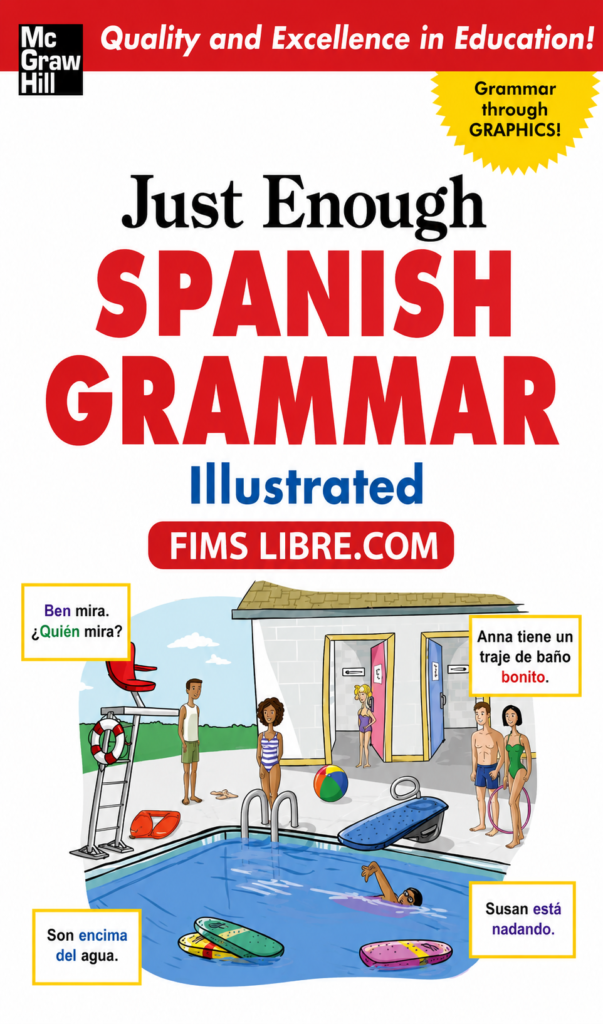
Just Enough Spanish Grammar Book Review
First Impressions
Honestly, I expected to read only a few chapters before taking a break, but I ended up continuing longer than planned. The lessons are fairly short, and that makes it easy to keep moving without feeling mentally exhausted.
What surprised me most was how readable the explanations were. Grammar books often feel like textbooks, but this one reads more like a practical guide. I wasn’t constantly stopping to reread paragraphs because the writing generally stays clear and straightforward.
A Quick Walk Through the Content
I usually approach grammar books with mixed feelings because they often become too technical after the first few chapters. Just Enough Spanish Grammar was a little different. Instead of trying to cover every grammar rule in exhaustive detail, it focuses on the essentials that learners actually need in order to understand and build everyday Spanish sentences.
The book begins with the foundations of the language, introducing sentence structure, pronunciation basics, articles, nouns, and adjectives before gradually moving into more challenging topics. Rather than assuming prior knowledge, it builds each concept step by step, making the learning process feel approachable instead of overwhelming.
As the chapters progress, the book explores verb conjugations, present, past, and future tenses, common irregular verbs, pronouns, prepositions, question formation, negatives, comparisons, and sentence construction. These topics are presented in a logical sequence, so one lesson naturally prepares you for the next.
One thing I appreciated was that grammar rules are usually followed by examples rather than lengthy explanations alone. Seeing how a rule works inside an actual sentence made it much easier to understand than simply reading definitions. I found myself paying more attention to the examples because they often clarified confusing points immediately.
The exercises throughout the book also help reinforce what has just been introduced. They aren’t designed to be difficult exams but instead encourage readers to practise the concepts while they’re still fresh. That gradual repetition made the material easier to retain without feeling repetitive.
Another helpful feature is that the explanations generally stay focused on practical communication. Instead of diving into advanced linguistic terminology, the book concentrates on grammar that people are likely to encounter while travelling, studying, or having everyday conversations. It doesn’t ignore important rules, but it also doesn’t make grammar feel unnecessarily intimidating.
Overall, the content feels like a bridge between a phrasebook and a full academic grammar guide. It gives learners enough structure to understand why Spanish sentences work the way they do without burying them under hundreds of exceptions all at once.
A Few Things I Liked
The strongest part of the book is its balance. It teaches enough grammar to build confidence without trying to turn beginners into language experts overnight.
I also liked how the examples were connected to everyday situations rather than strange or unrealistic sentences. That made it easier to imagine using the grammar in real conversations instead of treating it as something purely academic.
Another positive point was the pacing. New ideas appear gradually, giving readers time to absorb one concept before introducing another. Looking back, I think that steady progression is one of the reasons the book never felt intimidating.
A Couple of Weak Spots
To be fair, there were moments when I wanted a few more practice exercises after certain grammar topics. Some chapters ended just as I felt ready to test myself a little further.
I also noticed that learners who enjoy detailed explanations of every grammar exception might find the coverage a bit brief. Since the book intentionally focuses on “just enough” grammar, it occasionally leaves deeper discussions for other resources.
Maybe it’s just me, but I also would have appreciated a few more review sections that combined several grammar points into longer reading passages or conversations. That would have helped connect everything together even more naturally.
What I Took Away From It
After finishing the book, I felt far more comfortable understanding how Spanish sentences are built. It didn’t magically solve every grammar question I had, but it gave me a much stronger foundation than I expected.
I also realised that grammar doesn’t always have to feel intimidating. Presented in smaller pieces with practical examples, it becomes much easier to absorb over time. I found myself recognising patterns that had previously seemed confusing whenever I came across Spanish elsewhere.
Final Thoughts
If I’m being realistic, this isn’t the only grammar resource someone will ever need. Advanced learners will eventually want more detailed references, and complete beginners should probably combine it with listening practice and speaking exercises.
Still, I genuinely enjoyed working through it. The book stays focused on helping readers understand the most useful parts of Spanish grammar without unnecessary complexity. By the time I reached the final pages, I felt more confident reading and forming simple sentences than when I started, and that’s exactly what I had hoped to gain from it.
Join Our Facebook Learning Groups
🇩🇪 Learn German Free 🇬🇧 English Learning Group 🇪🇸 Spanish Learning GroupJoin our educational Facebook communities to improve your language skills, practice daily conversations, and connect with learners from around the world.