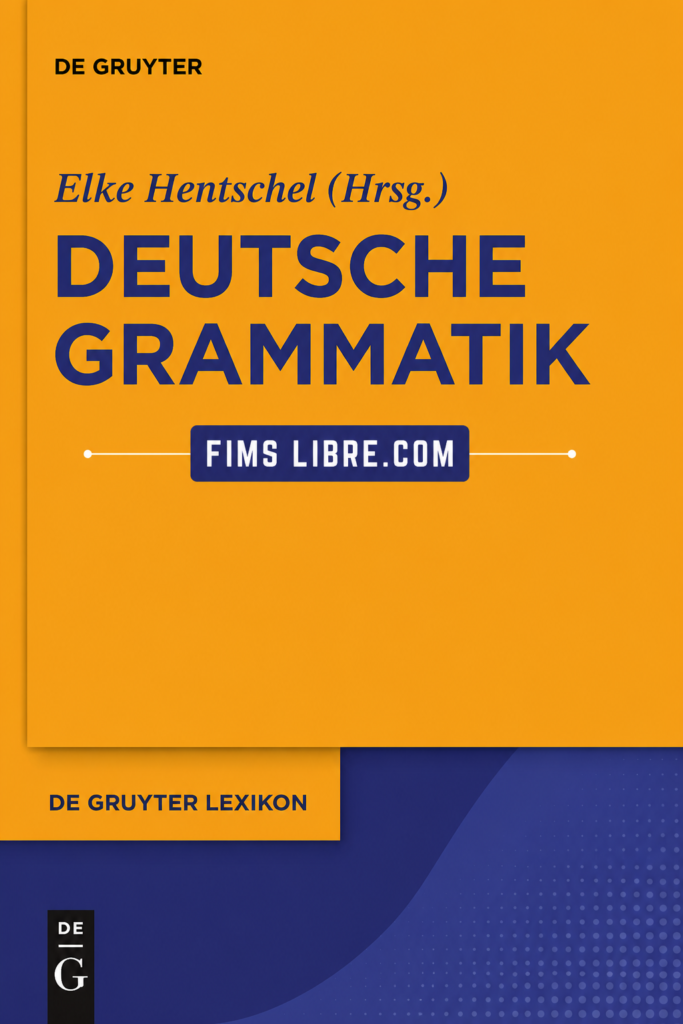
Deutsche Grammatik (de Gruyter Lexikon) – An Honest Reading Experience
A Closer Look at What’s Inside
I picked up Deutsche Grammatik (de Gruyter Lexikon) expecting a fairly traditional grammar reference, but it turned out to be much more detailed than I imagined. Rather than teaching German through conversations or short lessons, it focuses almost entirely on explaining how the language works. It feels like a reference guide that you can return to whenever a grammar question comes up instead of something you casually read from beginning to end.
The book covers the essential building blocks of German grammar in a systematic way. It explains nouns, articles, adjectives, pronouns, verbs, sentence structure, cases, prepositions, conjunctions, and many other topics that learners regularly struggle with. One thing I noticed is that the explanations often build upon earlier concepts, so the material feels connected rather than scattered.
A large portion of the book is dedicated to grammatical rules and their exceptions. German has plenty of those, and the author doesn’t try to oversimplify them. Instead, the explanations usually provide the reasoning behind the rules, along with examples that show how the structures appear in real sentences. That made it easier for me to understand why certain forms are correct instead of simply memorising them.
Another aspect I appreciated was the organisation. Although the content is extensive, it is arranged in a way that makes it relatively easy to locate a specific topic. I found myself jumping between chapters whenever I had a question about word order or verb placement, and it worked surprisingly well as a reference book.
The discussions about sentence construction were especially useful. German word order can become confusing once subordinate clauses and modal verbs appear, and the book spends enough time explaining these patterns without rushing through them. It also covers grammatical terminology quite thoroughly, which makes it particularly valuable for students who want more than a beginner’s overview.
Overall, the content is comprehensive rather than simplified. It assumes that the reader genuinely wants to understand grammar instead of just collecting useful phrases. Because of that, it feels more like having an encyclopaedia of German grammar on your desk than following a typical language course.
My Reading Experience
Honestly, this wasn’t the kind of book I could sit down and read for hours without taking breaks. The information is dense, and I quickly realised that treating it like a novel would be a mistake. Instead, I read a section, practised a few examples on my own, and then came back later. That approach worked much better.
What surprised me most was how often I returned to earlier chapters. Every time I thought I understood a grammar point, another section connected back to it. That constant reinforcement actually helped the ideas stick in my memory.
I also liked that the explanations rarely felt rushed. Even when the subject became complicated, I didn’t get the impression that the author was skipping important details. At one point I spent nearly half an hour reading about German cases because I wanted to understand the logic behind them rather than simply memorising tables.
Things That Worked Well
The biggest strength, in my opinion, is the depth. Whenever I had a grammar question, there was a good chance the answer appeared somewhere in the book. I wasn’t expecting such detailed treatment of topics that many learning books only mention briefly.
Another positive point is the structure. The chapters are organised logically, making it easier to revisit difficult subjects later. Looking back, I think this is one of those books that becomes more useful over time because you continue returning to it instead of finishing it once and putting it away.
The examples also deserve credit. They help illustrate rules instead of leaving everything at a theoretical level, which made some of the more difficult explanations easier to understand.
A Couple of Weak Spots
To be fair, this isn’t the friendliest grammar book for complete beginners. If someone has only just started learning German, the amount of information could feel overwhelming. I occasionally had to reread certain sections because the explanations assumed a little more grammatical knowledge than I expected.
Maybe it’s just me, but I also wished there were a few more practical exercises. The book explains grammar exceptionally well, yet I sometimes wanted additional opportunities to practise immediately after reading a difficult section.
The writing style is also quite academic. That makes sense considering the purpose of the book, but it isn’t always the easiest reading after a long day.
Final Thoughts
After spending time with this grammar guide, I see it less as a textbook and more as a long-term companion for serious German learners. It isn’t designed to entertain, and it doesn’t try to make every lesson feel effortless. Instead, it focuses on providing reliable explanations that you can trust whenever grammar becomes confusing.
If I’m being realistic, I probably won’t remember every rule from a single reading, but I know I’ll keep returning to this book whenever I need clarification. That, to me, is the mark of a genuinely useful reference. It requires patience, but if you’re willing to invest the time, it rewards careful reading with a much clearer understanding of how German grammar actually works.
Join Our Facebook Learning Groups
🇩🇪 Learn German Free 🇬🇧 English Learning Group 🇪🇸 Spanish Learning GroupJoin our educational Facebook communities to improve your language skills, practice daily conversations, and connect with learners from around the world.