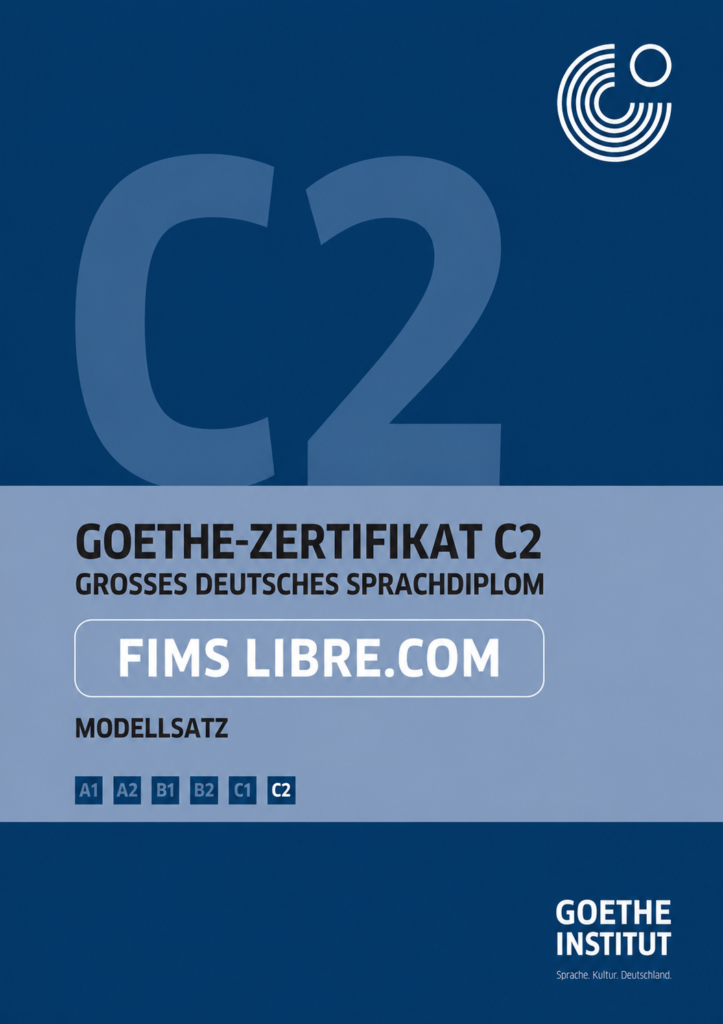
My Honest Experience with the Goethe-Zertifikat C2 Großes Deutsches Sprachdiplom Modellsatz
First Impressions
I had a feeling this wasn’t going to be an easy practice book, and I was right. The Goethe-Zertifikat C2 Großes Deutsches Sprachdiplom Modellsatz is clearly aimed at learners who are already comfortable using German in demanding academic and professional situations. From the first few pages, it became obvious that this isn’t a language course. It’s a full model examination designed to show candidates exactly what they can expect in the official C2 test.
The book doesn’t spend time explaining grammar rules or introducing new vocabulary. Instead, it assumes you’ve already reached an advanced level and now need realistic practice. I actually appreciated that because it keeps the focus on exam performance rather than language lessons.
A Quick Walk Through the Content
The model exam is organised around the four language skills assessed in the official Goethe C2 examination: reading, listening, writing and speaking. Everything follows the same structure and timing as the real test, which makes the experience feel surprisingly authentic. Rather than presenting isolated exercises, each section contributes to a complete exam simulation.
The reading part contains long, sophisticated texts taken from the kind of material educated native speakers might encounter. There are analytical articles, essays, reports and opinion-based texts that require careful interpretation. Many questions go beyond understanding individual words and instead ask the reader to recognise arguments, evaluate viewpoints and understand subtle meanings hidden between the lines. I noticed that concentration is just as important here as language ability.
The listening section raises the challenge even further. It includes lectures, interviews, discussions and formal presentations delivered at a natural pace with little simplification. Learners are expected to identify opinions, follow complex reasoning and remember detailed information over longer passages. It felt much closer to listening to real media than classroom recordings.
Writing tasks ask candidates to produce structured, well-reasoned texts rather than simple responses. The emphasis is on presenting clear arguments, developing ideas logically and adapting language to different situations. The speaking section follows the same philosophy by encouraging candidates to discuss complex topics, defend opinions and communicate naturally during formal conversations. These tasks measure not only language accuracy but also confidence, organisation and critical thinking.
Another useful part of the book is the inclusion of examiner materials and assessment guidance. While these are especially valuable for teachers, I found them equally helpful as a self-learner because they offered insight into what examiners are actually looking for. The overall impression is that this book functions as a complete rehearsal for one of the most demanding German language examinations rather than simply providing extra practice exercises.
My Reading Experience
Honestly, this book humbled me more than I expected. I’ve worked through lower-level Goethe materials before, but C2 feels like an entirely different world. At one point I caught myself rereading a single article because I understood every sentence individually but still wanted to make sure I had grasped the author’s overall argument.
What surprised me most was that the difficulty never felt artificial. The texts are challenging because the ideas themselves are complex, not because obscure vocabulary is thrown in for the sake of it. That made the learning experience much more rewarding.
I also found myself slowing down instead of rushing through the exercises. Normally, I like finishing practice books quickly, but this one encouraged me to pause, think and reflect before choosing an answer. Looking back, I think that actually improved my reading habits.
A Few Things I Liked
One of the biggest strengths is its authenticity. The model exam feels remarkably close to what I’d expect from a real high-level language assessment. It prepares you mentally as much as academically.
I also appreciated that every skill receives serious attention. Reading, listening, writing and speaking all require different strengths, and the book reminded me that mastering German isn’t about memorising grammar alone.
Maybe it’s just me, but I enjoyed the challenge. Even when I struggled, I never felt that the exercises were unfair or unnecessarily complicated.
A Couple of Weak Spots
To be fair, this isn’t a resource for someone who is still building their advanced German skills. Without a strong C1 foundation, the material could feel overwhelming rather than motivating.
I also wished there were more detailed explanations for some answers. While the examiner notes are useful, I occasionally wanted extra commentary explaining why one response was stronger than another, particularly in the writing and speaking sections.
Because it’s a model exam rather than a full course, you’ll almost certainly need additional grammar references, vocabulary practice and regular conversation outside the book.
Final Thoughts
If I’m being realistic, this book won’t magically take someone from B2 or C1 to C2. That’s simply not its purpose. Instead, it gives advanced learners an honest opportunity to measure their readiness for one of the highest recognised German language examinations.
By the end, I felt more aware of both my strengths and my limitations. More importantly, I had a much clearer understanding of the level of precision, confidence and critical thinking that C2 actually demands. It challenged me throughout, but in a way that felt worthwhile, and I finished it feeling better prepared than when I started.
Join Our Facebook Learning Groups
🇩🇪 Learn German Free 🇬🇧 English Learning Group 🇪🇸 Spanish Learning GroupJoin our educational Facebook communities to improve your language skills, practice daily conversations, and connect with learners from around the world.