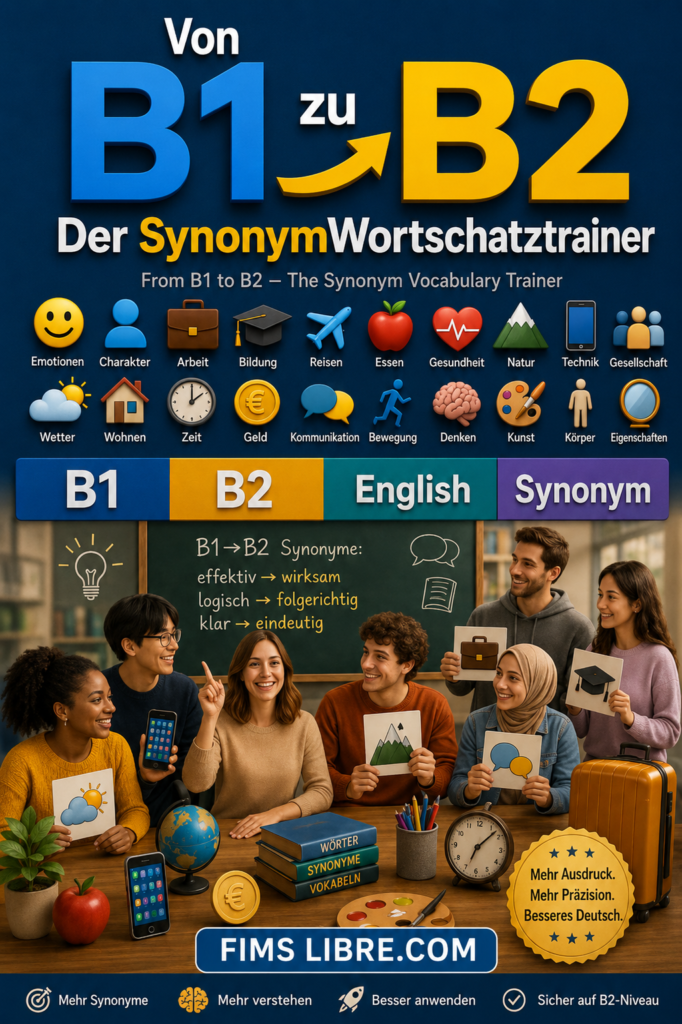
My Thoughts on This B1 to B2 German Vocabulary Trainer
When I first opened the digital file for this vocabulary guide, I wasn’t entirely sure what to expect. Language learning materials usually fall into two categories: either overwhelmingly dry textbooks packed with dense grammar rules, or overly simplistic phrasebooks that don’t really move the needle.
What caught my eye right away was the practical focus. The book promises to take learners from an intermediate (B1) level to an upper-intermediate (B2) standard specifically through synonyms and vocabulary expansion. As someone who always feels stuck using the same handful of basic words when speaking or writing a foreign language, the concept immediately felt relevant.
What’s This Book Really About?
At first glance, I thought this was simply another synonym dictionary for German learners. After spending some time with it, though, I realized it’s designed more like a guided vocabulary trainer for students moving from the B1 level to B2. Rather than introducing completely new grammar, the focus is on helping readers express themselves with greater variety and precision by replacing common words with stronger or more natural alternatives. It targets the exact plateau where many language learners get stuck—you know enough to make yourself understood, but your speech feels repetitive, basic, or monotone.
The material is organized around everyday topics and key thematic areas that commonly come up in B2-level exams and natural conversations:
- Core Life Themes: Sections are broken down into categories like emotions, personality traits, work, education, travel, health, nature, technology, and society.
- Abstract Concepts: It dives into specific modules covering time, money, communication, movement, thought processes, art, body, and personal characteristics.
- Direct Mappings: The fundamental structure pairs common B1 vocabulary directly with more sophisticated B2 alternatives. For instance, instead of relying on basic adjectives like effektiv (effective), logisch (logical), or klar (clear), the book introduces sharper nuances like wirksam, folgerichtig, and eindeutig.
Rather than just presenting a massive, overwhelming dictionary list, the layout aims to show you how to upgrade your word choice in real time, making your German sound richer, more precise, and far less reliant on direct translations from English.
My Reading Experience
Honestly, I enjoyed working through this book more than I expected. Vocabulary practice can sometimes become repetitive after twenty or thirty pages, but this one kept me interested because I could immediately use many of the new synonyms while writing simple German sentences.
I found myself stopping quite often to compare similar words. Sometimes I thought two expressions meant exactly the same thing, only to discover there were small differences in tone or usage. Those moments made the learning process much more engaging than simply memorizing definitions.
I also liked that the book doesn’t rush the reader. It allows enough space to absorb new vocabulary before moving on to another topic. Looking back, I think that slower pace actually helped me remember more words than faster vocabulary guides I’ve used before.
A Few Things I Liked
The organization is probably the strongest part of the book. Everything feels carefully arranged, and jumping back to previous chapters for revision is very easy. The themed structure also makes reviewing specific topics much less confusing.
Another strength is the emphasis on practical vocabulary. Most of the words seem genuinely useful for conversations, reading newspapers, or preparing for B2 examinations. I wasn’t expecting to recognize so many of the expressions later while reading German articles online, but it happened surprisingly often.
The explanations are also straightforward without becoming overly academic. Even when introducing less familiar vocabulary, the book avoids making the material unnecessarily complicated.
A Couple of Weak Spots
To be fair, there were moments when I wanted a little more guidance about the differences between certain synonyms. Some words are very close in meaning, and although examples help, I occasionally wished the author had added a short note explaining which expression sounds more formal or more common.
I also would have appreciated additional review exercises at the end of each chapter. The vocabulary itself is excellent, but without regular practice activities, I had to create my own revision routine to make sure the new words actually stayed in my memory.
Maybe it’s just me, but learners who prefer conversational dialogues over vocabulary-focused material may find parts of the book a little repetitive after longer study sessions.
Final Thoughts
By the time I finished the book, I didn’t feel like I had simply collected another long vocabulary list. Instead, I felt more aware of how small word choices can completely change the quality of a sentence. That was probably the biggest takeaway for me.
It’s not perfect, and I would have welcomed more exercises and a few deeper explanations for closely related synonyms. Still, the overall approach feels practical, organized, and genuinely useful for intermediate learners. If your goal is to move beyond basic German and become more confident using varied vocabulary, this trainer offers a steady and realistic way to build that skill without becoming overwhelming.
Join Our Facebook Learning Groups
🇩🇪 Learn German Free 🇬🇧 English Learning Group 🇪🇸 Spanish Learning GroupJoin our educational Facebook communities to improve your language skills, practice daily conversations, and connect with learners from around the world.