A Practical Companion for Building German Vocabulary
When I first opened Karl A. Schmidt’s Easy Ways to Enlarge Your German Vocabulary, I’ll be honest—I was expecting the usual dry, grammar-heavy manual that language learners usually have to drag themselves through. Most language guides treat vocabulary acquisition like a mechanical exercise in rote memorization, which always leaves me feeling exhausted after three pages.
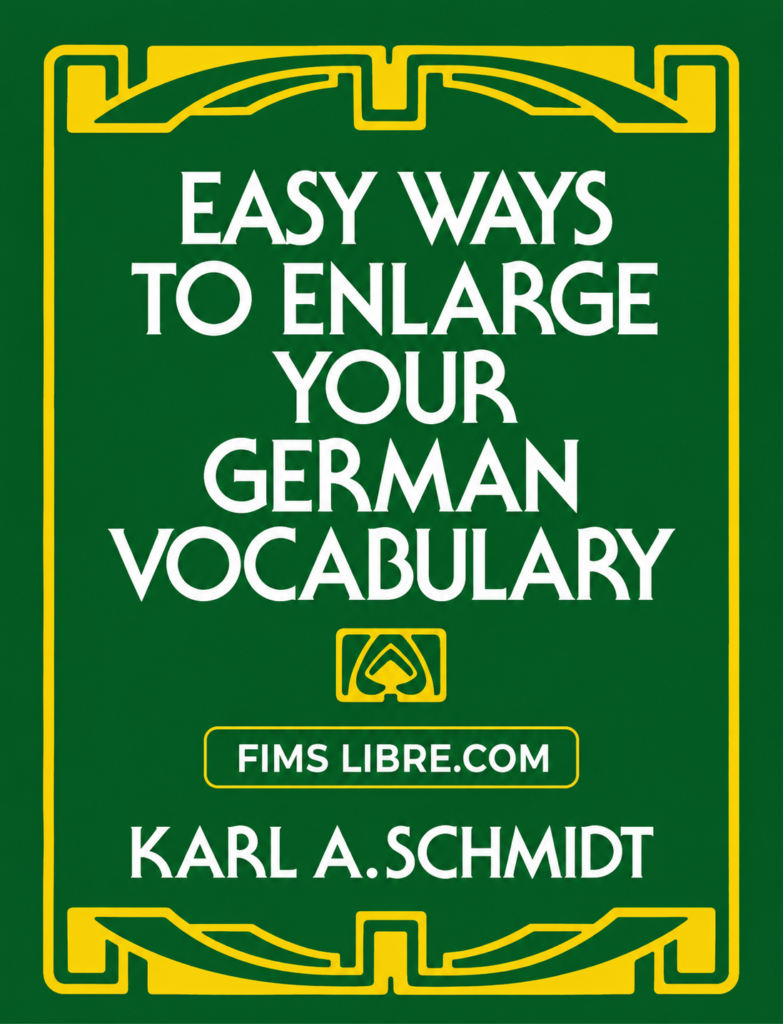
What made me pick this one up was simply a desire to find a less painful way to expand my word bank without resorting to endless flashcard apps. The classic, straightforward cover gave me the vibe of an old-school study companion, and I was curious to see if its practical claims held up to actual reading
What’s This Book Really About?
To give you a proper overview, the book spends its roughly 120 pages breaking down the German language into logical, interconnected building blocks rather than throwing random lists of words at you. The core focus is on teaching you how German words are constructed, so you can decipher new vocabulary on your own rather than memorizing every term in isolation.
Karl A. Schmidt structures the material systematically across several key areas:
- Cognates and English Connections: The text begins by leveraging what English speakers already know. It demonstrates how letter shifts (like $d$ to $t$, or $f/v$ to $b$) link hundreds of German words directly to their English equivalents.
- Prefixes and Suffixes: A substantial section details how modifying root words with prefixes (such as be-, ver-, or zer-) completely alters meaning, allowing you to multiply your vocabulary from a single base word.
- Compound Nouns: The guide demystifies those notoriously long German compound words by showing how to break them down into recognizable smaller components.
- Word Families and Stems: By grouping words around shared root verbs or nouns, the book shows how a single root can generate dozens of related nouns, adjectives, and adverbs.
- Practical Word Lists and Exercises: Throughout the chapters, Schmidt includes structured practice sections and thematic word groups designed to reinforce the structural rules explained in the text.
Instead of treating German as an alien system, about forty percent of the book functions as a structural roadmap, showing how the language builds on itself through regular patterns.
My Reading Experience
Honestly, I enjoyed this book more than I thought I would. Vocabulary books usually feel repetitive after a few chapters, but this one kept my attention because I could immediately test the ideas while reading German articles online. Every time I recognized a familiar root inside a longer word, it felt like solving a small puzzle.
The writing style is quite straightforward. It doesn’t try to entertain the reader with stories or unnecessary examples, and in some ways that works well. At the same time, there were moments where I wished the explanations included a few more modern examples or short practice exercises. Sometimes I had to pause and create my own examples just to make sure I had fully understood the concept.
I also liked that the author respects the reader’s ability to think independently. Instead of spoon-feeding every detail, the book encourages you to notice patterns yourself. Looking back, I think that’s one of the reasons the lessons stayed with me longer than expected.
Things That Stood Out to Me
What surprised me most while working through the material was how much lighter the mental load felt compared to traditional vocabulary building. I found myself having a few genuine “aha!” moments, particularly in the sections covering letter shifts between English and German. Realizing that a simple sound shift explains why Tageszeit or Wasser look the way they do made the language feel instantly more accessible.
Another strong point is how the author handles compound nouns. If you’ve ever looked at a German word that spans half a line and felt immediate panic, Schmidt’s method of slicing it into digestible root pieces feels like turning a secret key. It changes your mindset from passive memorization to active decoding.
What I Took Away From It
Maybe it’s just me, but I think this book works best as a companion rather than a complete language course. It won’t teach you everything you need to speak German fluently, and it doesn’t try to. Instead, it strengthens one very specific skill: understanding how German words are built.
After finishing it, I felt more confident reading unfamiliar texts because I could often guess the meaning of new words before checking a dictionary. That alone made reading in German less intimidating.
I also realized that learning vocabulary becomes much easier when words are connected instead of isolated. That’s probably the biggest lesson I carried away from the book.
Who Will Probably Enjoy This?
I’d recommend it to learners who already know basic German and want to expand their vocabulary in a smarter way. Students preparing for reading-heavy exams, self-learners, and anyone who enjoys understanding language patterns will likely get the most value from it.
Complete beginners might find some sections challenging because the book assumes a little familiarity with German. On the other hand, advanced learners may already know many of the examples, although the explanations of word formation can still be worthwhile.
Final Thoughts
By the time I reached the last chapter, I didn’t feel like I had simply memorized more German words. Instead, I felt that I had learned a strategy for recognizing new vocabulary on my own. That’s a much more useful skill in the long run.
The book certainly has a few dated moments, and I occasionally wanted more exercises to reinforce the lessons. Still, its core ideas remain practical and surprisingly effective. If your goal is to understand German vocabulary instead of endlessly memorizing isolated word lists, this is a thoughtful resource that offers a different perspective on language learning.
Join Our Facebook Learning Groups
🇩🇪 Learn German Free 🇬🇧 English Learning Group 🇪🇸 Spanish Learning GroupJoin our educational Facebook communities to improve your language skills, practice daily conversations, and connect with learners from around the world.