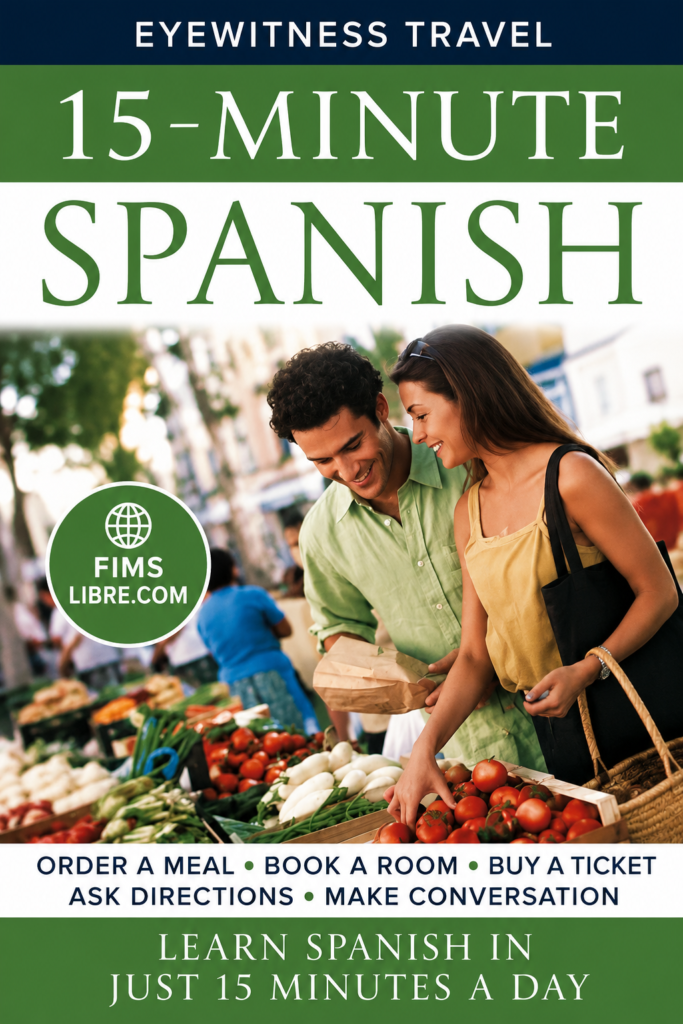
First Impressions
I picked up Learn Spanish in Just 15 Minutes a Day expecting another language guide filled with long grammar explanations and endless vocabulary lists. Honestly, I wasn’t expecting much beyond a basic phrasebook. Instead, I found something that feels surprisingly approachable. Rather than overwhelming the reader, the book breaks learning into short daily sessions that are easy to fit into a busy routine. Even if someone has never studied Spanish before, it never feels intimidating.
What caught my attention almost immediately was the layout. Every lesson is visual, organized, and focused on real-life situations instead of abstract grammar. It reminded me more of working through practical conversations than sitting in a classroom.
A Quick Walk Through the Content
Around forty percent of what makes this book valuable is simply how well it is organized. The course is divided into twelve themed weeks, covering situations like introductions, restaurants, travel, shopping, accommodation, work, health, and everyday conversations. Each week contains several short lessons followed by review exercises, allowing readers to reinforce what they have just learned instead of rushing ahead.
I also liked the way pronunciation is handled. Every important word and phrase comes with an easy pronunciation guide, which makes speaking less intimidating. There are illustrated conversations, cultural notes, quick vocabulary sections, and short exercises that encourage active learning rather than passive reading. The book even includes a menu guide and bilingual dictionaries for quick reference later on.
One feature I genuinely appreciated was the self-testing system using the cover flaps. Instead of simply reading the Spanish words repeatedly, you’re encouraged to hide the answers and recall them from memory. It sounds simple, but I found myself remembering phrases much faster because of this approach.
Another thing I noticed is that the lessons focus on situations people actually encounter while traveling or meeting Spanish speakers. Ordering coffee, asking for directions, booking hotels, introducing yourself, or shopping all appear naturally throughout the course instead of feeling randomly selected.
Things That Stood Out to Me
What surprised me most was how practical everything feels. The authors don’t try to teach every grammar rule immediately. Instead, they introduce useful phrases first and explain grammar only when it’s actually needed.
I found myself speaking some of the dialogues aloud, which is something I rarely do with language books. Because the lessons are short, it never felt exhausting. Finishing one lesson gave me the feeling that I had actually learned something useful instead of just memorizing isolated words.
The cultural tips were another pleasant surprise. Small notes explaining greetings, cafés, restaurants, and everyday customs make the lessons feel connected to real Spanish life rather than just vocabulary drills. Those little details add personality to the learning experience.
A Couple of Weak Spots
To be fair, the book isn’t perfect.
If you’re someone who enjoys understanding grammar in depth, you may feel that certain explanations move a little too quickly. Some verb forms appear with only brief explanations before the book continues to the next topic.
If I have one frustration, it’s that it can feel a bit repetitive if you try to sit down and read through it too quickly. It’s definitely designed to be used in small, daily bites. If you have a longer period to study, you might find yourself wishing for a bit more depth in the explanations rather than just the “phrasebook” style approach. There were times when I wanted to know why a sentence was structured a certain way, but the book understandably prioritizes getting you to speak over deep linguistic theory.
My Reading Experience
Reading this felt less like studying and more like following a daily habit. I never felt pressured to finish several chapters in one sitting. Instead, I could complete a lesson in a few minutes and come back later without feeling lost.
At one point I realized I was remembering common greetings and simple questions almost automatically. That doesn’t mean the book magically makes someone fluent, of course, but it definitely builds confidence. I think confidence is often the hardest part of learning a new language, and this guide quietly helps with that.
Looking back, I appreciate that the authors chose consistency over complexity. Rather than trying to impress readers with advanced material, they focus on helping people make steady progress through repetition and practical situations.
Final Thoughts
After spending time with Learn Spanish in Just 15 Minutes a Day, I came away with a positive impression. It’s not designed to replace a full language course, nor does it pretend to. Instead, it provides a realistic starting point for anyone who wants to build useful Spanish little by little.
Its greatest strength is its simplicity. The short lessons, visual format, pronunciation help, practical conversations, and regular review sessions make learning feel manageable instead of overwhelming. While I would have welcomed deeper grammar explanations and more advanced practice, those limitations never overshadowed the book’s main purpose.
If you’re looking for a gentle introduction to Spanish that fits into everyday life, this is an enjoyable place to begin. I finished it feeling encouraged rather than exhausted, and that’s probably the biggest compliment I can give any beginner language book.
Join Our Facebook Learning Groups
🇩🇪 Learn German Free 🇬🇧 English Learning Group 🇪🇸 Spanish Learning GroupJoin our educational Facebook communities to improve your language skills, practice daily conversations, and connect with learners from around the world.